Search This Blog

Showing posts with label #C3WP. Show all posts

Tuesday, February 19, 2019

Finding Just Right Evidence by Cole Marion

My group's breakout session was "Finding Just Right Evidence" to help support the writer's  own personal claim. Some of the components we discussed were finding evidence that was compelling, debatable, and defensible. We examined several pieces of writing that had all three of these components, and others that only had a couple or none at all. We would rank these pieces of evidence from strongest to weakest then share. 

Dunseith Social Studies teacher Cole Marion and Robert Rivera-Amezola of the Philadelphia Writing Project at the C3WP Mid-Year Meeting in Atlanta Feb. 9-10, 2019
A couple takeaways I got from this session led by Robert Rivera-Amezola was identifying all evidence before constructing a claim and ranking all possible evidence before choosing the best evidence to support your claim. Identifying first all possible evidence before you make a claim is helpful for students because they have all the possible evidence at hand before they put down their final claim. Students can distinguish between both sides of the argument and choose the best evidence that helps supports their claim or thinking. Another takeaway I got was ranking your evidence before choosing which piece you want to implement into your claim. Ranking evidence will help students determine which is irrelevant and which is the best to help support their claim. 
Cole Marion (in plaid shirt at left) working hard to build his knowledge of the College, Career, and Community Writers Program (C3WP) with teachers from all over the country.

This is something I can implement into my classroom through modeling and ongoing practice from my students and me. Both support my students in the type of writing they currently do, and it will help students identify just right evidence in our readings.     

Sunday, August 12, 2018

Launch of the C3WP Elementary Advanced Institute

Bringing Students into the Conversation
by Angela Hase


“We have to let children speak.” This quote said by participant Kathy on the first day of the Upper Elementary AI is bouncing around in my head. I am sitting in the Devil’s Lake Holiday Inn conference room working with a group of elementary teachers from Langdon, Harvey, Center-Stanton, led by RRVWP TCs Lisa Gusewelle and Emily Olson. We are engaged in a two-day conversation about argument writing in elementary classrooms. Together, we are learning the C3WP instructional resources with the goal of introducing skills for teaching argument to upper elementary teachers in Belcourt and Dunseith districts during the 2018-2019 school year, as part of three-year i3 grant the RRVWP received from the National Writing Project to scale up the College, Career, and Community Writers Program in rural, high-needs schools.

Yesterday, we spent a day focusing on how much of argument writing is understanding that arguments are everywhere. Arguments are part of every decision we make, of the screens we scroll through and consume, and of the outside world that bombards us in advertisements from billboards to the songs lyrics hoping we live life to the fullest or forget that crush. Arguments are even in wrappers from our favorite fast food restaurants. Are you really “loving it”? Can you have it “your way”?

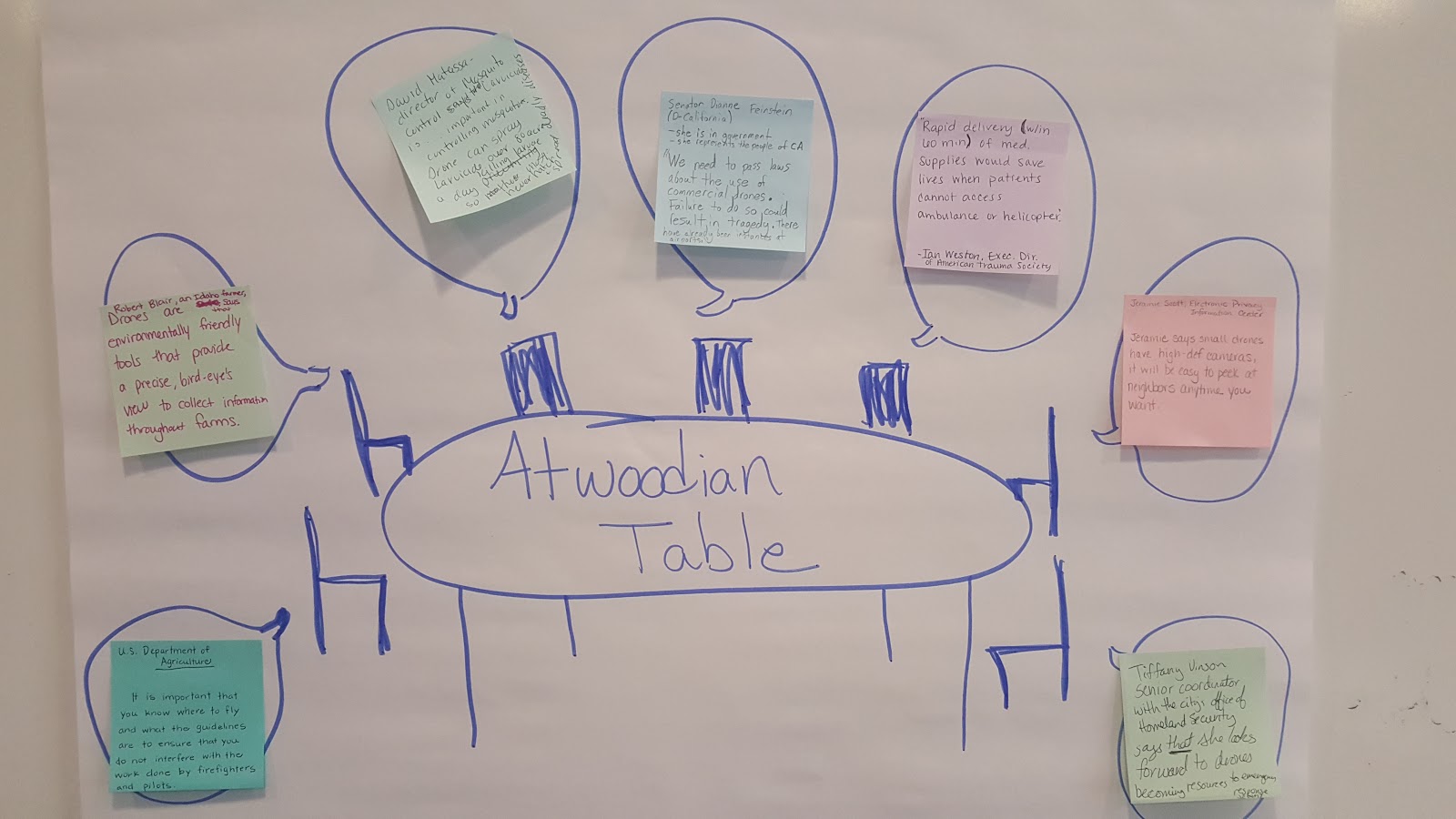
This morning, we tried the Atwoodian table, a play on the Burkean Parlor by Kenneth Burke. A brief description of the Atwoodian table is to think about who is in the conversation at a round table. All of the people involved in the text get their own seat at the table. The table is round because no one person is at the head, instead everyone is an equal participant.

Our conversation was about drones. In the instructional resource Entering the Conversation: Joining a Conversation in Progress, we read perspectives (one or two sentences) from a variety of sources:

Wednesday, September 6, 2017

How the RRVWP Spent Its Summer Vacation Part #1: Completion of the First College-Ready Writers Program Advanced Institute; Launch of the Second


L to R: Tanya, Kim, Angie, Lisa, Nancy, Becky, Tammy, and Kelly
Congratulations to the following teachers on completing the RRVWP's first College-Ready Writers Program (CRWP) Advanced Institute: Ann Duchscher, Becky Fisher, Nancy Gourde, Lisa Gusewelle, Angie Hase,  Tanya Neumiller, Cadie Olson, Tammy Linn, and Kim Rensch. In addition, Angie Hase co-facilitated the institute with NDSU Associate Professor, Kelly Sassi, who also serves on the national leadership team for the CRWP.
Ann, Kim, Nancy, Tanya, Tammy, and Becky

The CRWP focuses on the teaching of source-based argument writing. The teachers taught at least four cycles of argument writing and brought student work to the institute for formative assessment using the tools developed by the National Writing Project. A cycle of writing in the CRWP looks like this:


The RRVWP chose to pursue a grant to offer this professional development to teachers because of the success of the CRWP in independent randomized-control research. Students who have experienced C3WP out-performed other students in writing. The research results can be found here. The data included implementation in 10 states and 22 school districts across 12 writing project sites. It includes many rural, high-needs schools. CRWP had a positive, statistically significant effect on the four attributes of student argument writing—content, structure, stance, and conventions. Interestingly, although explicit teaching of grammar is not part of the program, there were gains in writing conventions. Teachers have also highly enjoyed this professional development and have found it to be rewarding. We have featured the success stories of our first cohort of teachers on this blog throughout the year.

The National Writing Project is scaling up the CRWP, which has a new name, the C3WP (College, Career, and Community Writers Program). The Red River Valley Writing Project contributed district commitment letters to the National Writing Project's i3 grant proposal, which was awarded in January 2017. This $36 million grant will allow the NWP to reach more states and districts through 2020.

The RRVWP launched the next Advanced Institute in C3WP August 8-10 in Fargo and it continues through the 2017-18 academic year with virtual and in-person meetings.

Advanced Institute participants committed to teaching four cycles of argument writing in the 2017-18 academic year and participating in two rounds of formative assessment in which they use National Writing Project tools to analyze student writing. Cycles of writing arecomprised of brief routine argument writing and mini units as well as extended researched arguments. RRVWP teacher leaders support participants in planning that fits each teacher's context.