Bringing Students into the Conversation
by Angela Hase
“We have to let children speak.” This quote said by participant Kathy on the first day of the Upper Elementary AI is bouncing around in my head. I am sitting in the Devil’s Lake Holiday Inn conference room working with a group of elementary teachers from Langdon, Harvey, Center-Stanton, led by RRVWP TCs Lisa Gusewelle and Emily Olson. We are engaged in a two-day conversation about argument writing in elementary classrooms. Together, we are learning the C3WP instructional resources with the goal of introducing skills for teaching argument to upper elementary teachers in Belcourt and Dunseith districts during the 2018-2019 school year, as part of three-year i3 grant the RRVWP received from the National Writing Project to scale up the College, Career, and Community Writers Program in rural, high-needs schools.
Yesterday, we spent a day focusing on how much of argument writing is understanding that arguments are everywhere. Arguments are part of every decision we make, of the screens we scroll through and consume, and of the outside world that bombards us in advertisements from billboards to the songs lyrics hoping we live life to the fullest or forget that crush. Arguments are even in wrappers from our favorite fast food restaurants. Are you really “loving it”? Can you have it “your way”?
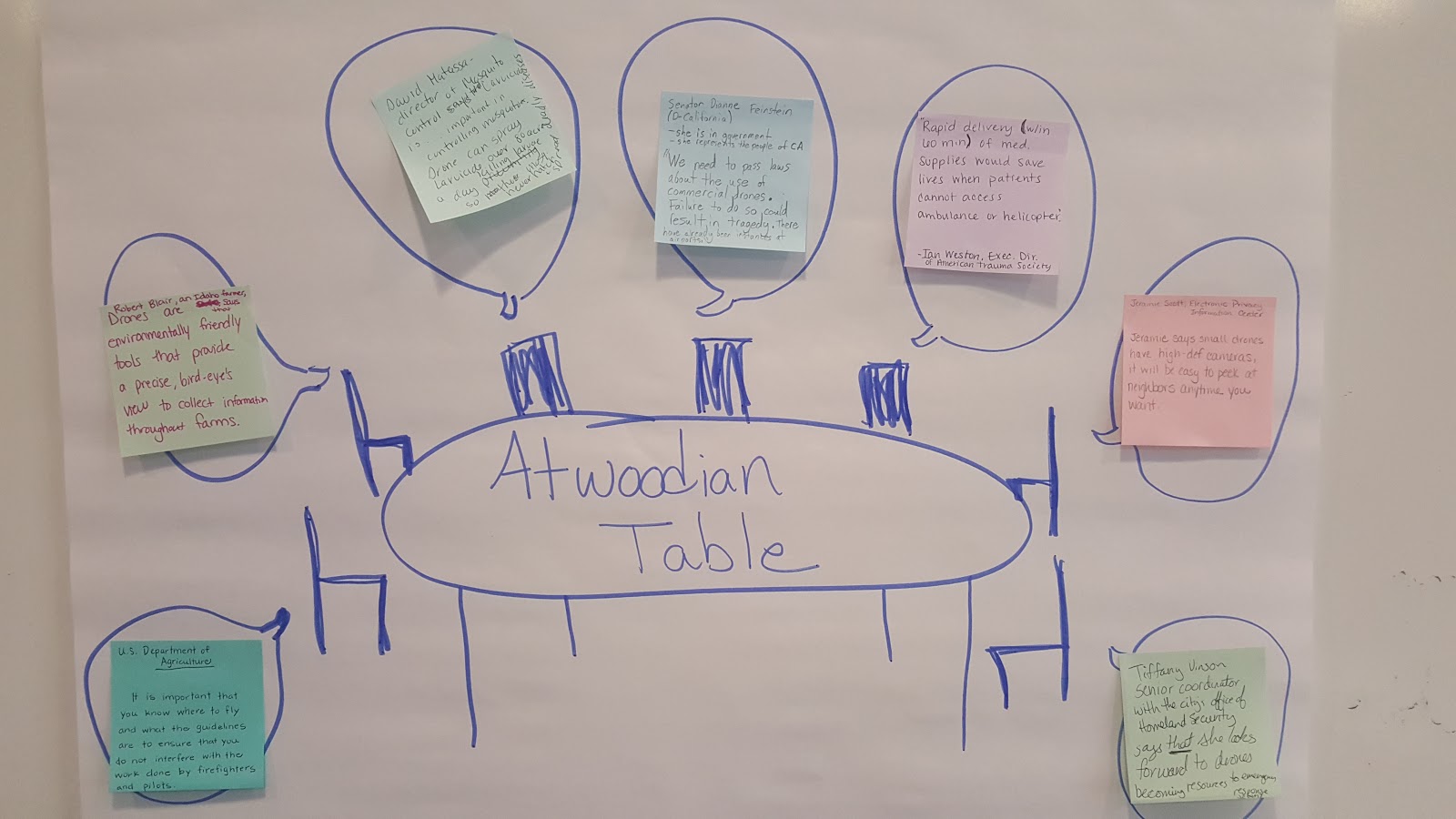
This morning, we tried the Atwoodian table, a play on the Burkean Parlor by Kenneth Burke. A brief description of the Atwoodian table is to think about who is in the conversation at a round table. All of the people involved in the text get their own seat at the table. The table is round because no one person is at the head, instead everyone is an equal participant.
Our conversation was about drones. In the instructional resource Entering the Conversation: Joining a Conversation in Progress, we read perspectives (one or two sentences) from a variety of sources:

